The Classic Plumber — Knoxville's Plumbing Expert
Burst pipe, sewer backup, or no hot water? Call (865) 659-8294Human service Mon–Fri 7:30–5 · After hours, call anyway—we’ll confirm availability right away · AI guidance 24/7
[COLD WEATHER PLUMBING GUIDE — KNOXVILLE, TN]

Cold Weather Plumbing Checklist for Knoxville Homes

East Tennessee does not stay cold long, and that is exactly why frozen pipes catch people off guard. Use this guide before the first hard freeze, the night before a cold snap, and if water stops coming out of a faucet.

Knoxville, Knox County & surrounding East Tennessee

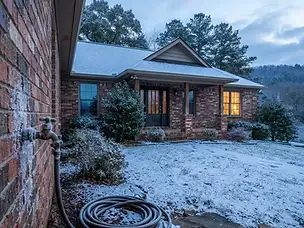
East Tennessee home after a light snowfall with frost on an outdoor faucet
[THE SHORT VERSION]

Three things do most of the work

Disconnect and cover outside

Hoses off, hose bibbs drained, insulated covers on. The exterior faucet is the most common freeze failure in this area.

Seal cold air out

Closed crawlspace vents, sealed pipe penetrations, intact insulation. Cold moving air freezes pipe that still insulation would have protected.

Know the shutoff and thaw gently

If a line freezes, shut off the main if anything looks split, then thaw with a hair dryer or warm towels — never a torch.

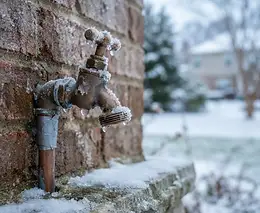
Frost on an outdoor faucet before a Knoxville freeze

What freezes first in a Knoxville home

Exterior hose bibbs, supply lines on exterior walls (especially behind kitchen and bathroom cabinets), piping above garages and in crawlspaces, unheated laundry rooms, and any line sitting in a draft. Slab homes are more forgiving than crawlspaces, but a pipe in an exterior wall will still freeze in an extended cold snap.

[THE FULL CHECKLIST]

Work through it in order: before, during, and after

Everything below is a safe visual check or a homeowner-level task. Anything that requires opening a wall, working on energized equipment, or reaching piping you cannot see should wait for a plumber.

[01 — BEFORE THE FIRST FREEZE]

Get the outdoor plumbing ready

Most freeze damage in Knoxville homes starts outside or just inside the foundation wall. Handle these before the first night in the twenties.

  • Disconnect every garden hose and drain it. A hose left connected traps water in the faucet and the pipe behind it.
  • For hose bibbs with an operable dedicated interior shutoff, shut off the supply and drain the downstream section according to its design. Do not force a stuck valve; trapped water may remain if the piping does not drain correctly.
  • Install suitable insulated faucet covers with hoses removed. Covers slow heat loss but cannot guarantee freeze protection during prolonged cold or when the indoor side is unheated. Repair leaks first.
  • Check frost-free hose bibbs. A frost-free faucet that drips or will not shut off completely can freeze and split inside the wall.
  • Turn off and drain irrigation systems, sprinkler backflow assemblies, and pool or fountain lines per their instructions.
  • Disconnect and drain the washing machine hoses if the machine sits against an exterior wall in an unheated space.

[02 — INSULATE AND SEAL]

Protect the piping you can reach

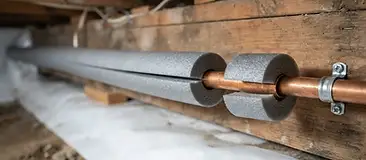
Insulation slows heat loss; it does not create heat. The goal is to keep the pipe inside the warm envelope of the house, or at least out of moving cold air.

  • Insulate exposed copper, PEX, and CPVC in crawlspaces, garages, attics, and on exterior walls using the correct size foam or fiberglass pipe insulation.
  • Seal gaps where pipes pass through the rim joist, foundation wall, or siding. Cold air pouring through a half-inch hole can freeze a line that insulation is trying to protect.
  • Secure crawlspace access doors and address drafts around piping. Do not block combustion-air openings or required ventilation; ask a professional before changing crawlspace vent arrangements.
  • Check that the crawlspace vapor barrier is intact and that no insulation has fallen away from the subfloor above the piping.
  • Keep the garage door closed during cold snaps when plumbing runs through or above the garage.
  • Look for uninsulated piping above garage ceilings, under kitchen sink bump-outs, and in unheated basement stairwells — the common trouble spots in East Tennessee homes.

[03 — THE DAY BEFORE A HARD FREEZE]

Set the house up for a cold night

A few minutes of preparation the evening before a hard freeze prevents most of the calls we get the morning after.

  • Locate the main water shutoff and make sure it actually turns. Show everyone in the house where it is.
  • Maintain consistent indoor heat; when away, the Red Cross recommends no lower than 55°F. Vulnerable plumbing may require warmer settings. That minimum is not a guarantee against freezing.
  • Open cabinet doors under exterior-wall sinks so warm air reaches plumbing; move cleaners and chemicals out of reach of children and pets.
  • When freezing weather threatens vulnerable supply lines, a small trickle can help reduce risk. Follow local utility guidance, protect both hot and cold runs where exposed, and ensure the drain is clear. Dripping does not guarantee protection.
  • Inspect listed pipe-heating cable for damage and follow its installation instructions. Do not use improvised heat lamps or leave portable heaters unattended; see the equipment precautions below.
  • Check smoke and carbon monoxide alarms before you add any supplemental heat source.
  • If you will be away, arrange temperature monitoring and someone to inspect the house. Ask about professional winterization if heat cannot be maintained; closing a valve and opening faucets alone does not fully drain equipment or all piping.

[04 — DURING THE FREEZE]

Watch, don't poke

Once temperatures are below freezing, the safest thing you can do is keep the heat steady and watch for the warning signs.

  • Keep interior doors open so warm air can move between rooms, especially near bathrooms and laundry areas on exterior walls.
  • Leave cabinet doors open under exterior-wall sinks until temperatures climb back above freezing.
  • Watch for a faucet that suddenly has no water or only a trickle — that is the most common first sign of a frozen line.
  • Watch for frost on a pipe, a bulging pipe, or a pipe that looks distorted. Stop and call a plumber before it splits.
  • Do not open crawlspace doors or vents to “check on it” during the coldest hours. You are letting the cold air in.
  • Never use an open flame, torch, charcoal, or a grill to warm plumbing or a crawlspace.

[05 — IF A PIPE FREEZES]

Thaw gently, or call

A frozen pipe is not yet a broken pipe. Water damage usually happens while thawing or when the ice expands and splits the pipe.

  • Leave the affected faucet open. As the ice melts, the water needs somewhere to go, and running water helps clear the line.
  • Shut off the water at the main if you see bulging, cracking, or any sign of a split.
  • Apply gentle heat: a hair dryer on low, a heat pad, or warm (not boiling) towels wrapped around the pipe. Work from the faucet end back toward the frozen section.
  • Open the cabinet so room air can reach the pipe, and warm the room if it is safe to do so.
  • Do not pour boiling water on a frozen pipe or drain. Thermal shock can crack copper, PVC, and porcelain.
  • Call a plumber if the frozen section is inside a wall, slab, or crawlspace you cannot safely reach, if the pipe is bulging or cracked, or if you cannot find the frozen section.

[06 — AFTER THE THAW]

Check for the damage that shows up later

Many split pipes do not leak until the ice melts and pressure returns. The first warm day is when we find most winter damage.

  • Walk the house and look for water stains on ceilings, walls, and cabinet bottoms, and for damp spots in the crawlspace.
  • Check the water meter with every fixture off. If the low-flow indicator is still moving, water is escaping somewhere.
  • Look at exposed piping in the crawlspace, garage, and under sinks for splits, weeping joints, or crushed insulation.
  • Run every faucet, flush every toilet, and run the washing machine and dishwasher briefly to confirm normal flow and drainage.
  • Check the water heater and its pan, connections, and T&P discharge for moisture after a cold snap.
  • Photograph anything wet or damaged before you clean up. It helps with insurance and with the repair.
[WHAT HOMEOWNERS ACTUALLY BUY]

Cold-weather supplies, and how each one is meant to be used

None of these are a substitute for shutting off and draining a line that has already failed. Used correctly, they buy time and prevent the most common freeze damage.

Foam pipe insulation installed on a copper water pipe

Pipe insulation

Closed-cell foam or fiberglass sleeves that slow heat loss on exposed supply lines in crawlspaces, garages, and attics.

Buy the size that matches the pipe — insulation with an oversized or crushed bore leaves an air gap and performs poorly.

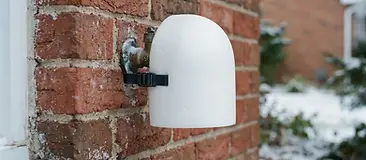
Insulated foam cover installed over an outdoor hose bibb on a brick wall

Outdoor faucet cover

An insulated foam dome that straps over an exterior hose bibb to hold a pocket of warmer air against the faucet.

Works best on a faucet that does not drip. Remove it in spring so the faucet and wall can dry out.

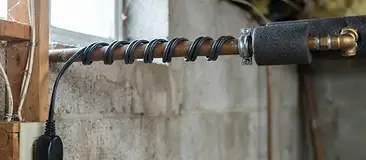
Electric heat tape wrapped around a copper water pipe in a basement

Heat tape (heat cable)

Listed pipe-heating cable adds heat to vulnerable piping. Designs vary: some run straight along the pipe and others permit wrapping. Follow the exact product instructions; an illustration is not an installation diagram.

Only use a listed product rated for the pipe material, install it per the manufacturer's instructions, never overlap or cover it with insulation unless approved, and plug it into GFCI protection.

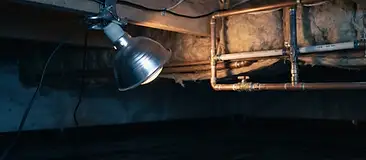
Clamp-on reflector heat lamp aimed at exposed water pipes in a crawlspace

Heat lamp

A radiant heat lamp shown for identification, not as a recommended DIY crawlspace heating method.

We do not recommend improvised clamp-on heat lamps for plumbing protection. A fallen or displaced lamp can ignite nearby materials. Have a professional select listed equipment suitable for the location; never leave temporary heat unattended.

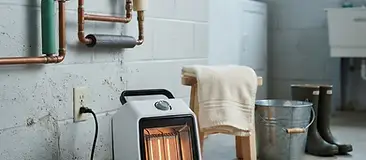
Portable electric space heater in a utility room near exterior wall piping

Space heater

A portable heater that can keep a small utility room, pump room, or garage above freezing during a cold snap.

Use a listed heater with tip-over and overheat protection, on a stable dry surface with at least three feet of clearance or the greater clearance its instructions require. Plug directly into a wall outlet, never an extension cord or power strip. Never leave it unattended or running while asleep; do not use it in a wet crawlspace.

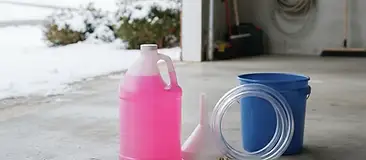
Jug of pink RV antifreeze with a funnel and tubing in a garage

RV antifreeze

Propylene-glycol antifreeze used to protect RV, boat, and cabin fresh-water systems, drains, and traps that will sit unused in freezing weather.

Use only a product specifically labeled for the system and materials being winterized. Never use automotive antifreeze. Do not add it to an occupied home's active drinking-water system. Compatible isolated seasonal systems may use labeled RV/waterline antifreeze under a proper winterization and flushing procedure. Ready-to-use products must not be diluted unless their label allows it; burst protection is not the same as freeze temperature.

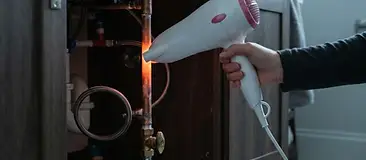
Hair dryer warming a copper pipe inside a bathroom vanity cabinet

Hair dryer

A gentle heat option for an accessible intact pipe in a dry location, when the appliance instructions permit.

Keep the dryer and electrical connections dry, away from standing water and leaks, and use GFCI protection. Never operate electrical equipment while standing in water. Keep it moving and attended. If the pipe is damaged, hidden, or inaccessible, stop and call.

Product photos are illustrative. Always follow the manufacturer's instructions and local code for the specific product installed in your home.

Safety rules that are not negotiable

Most winter plumbing injuries and house fires we hear about involve a heat source applied to plumbing or used in a crawlspace. These rules matter more than any product on this page.

  • Never use a torch, open flame, charcoal, or a propane heater to thaw plumbing or warm a crawlspace.
  • Never run a generator, grill, or fuel-burning heater indoors or in a garage — carbon monoxide kills quietly.
  • Keep space heaters and heat lamps clear of wood, paper, and pipe insulation, and never leave them unattended.
  • Never use automotive antifreeze in plumbing. Use RV/waterline antifreeze only in compatible isolated systems or traps according to the product label and equipment instructions, with required flushing before returning to service.
  • Do not pour boiling water on a frozen pipe or drain — thermal shock can crack copper, PVC, and fixtures.
  • If a pipe is bulging, cracked, or already leaking, shut off the main and call a plumber instead of thawing it yourself.

If you smell gas, see smoke or fire, or there is an immediate threat to life, leave the area and call 911 or the responsible utility first.

[NOT EVERY HOME IS THE SAME]

Situations that need more than a faucet cover

Vacant homes, rentals, and cabins

An unmonitored vacant house can lose heat or develop leaks without anyone noticing. Winterizing properly means shutting off and draining the water system, protecting traps and fixtures, addressing the water heater, and documenting what was done. Re-activation should include a controlled fill and a real leak check — not just turning the valve back on.

Manufactured and mobile homes

Belly insulation, heat tape, and skirting are doing most of the work. Check that the skirting is intact, that the underbelly is not torn or hanging, and that any heat tape is actually powered through a working GFCI. A single open skirting panel on a windy night can freeze the water line.

Tankless water heaters

Some tankless models have built-in freeze protection that requires power and, depending on the model, fuel. It does not necessarily protect external piping. If the unit loses power during an outage, or if the condensate line freezes, you can end up with a locked-out heater or a cracked heat exchanger. Keep the unit powered, keep the condensate line clear, and follow the manufacturer's freeze-protection guidance.

Older Knoxville homes

Galvanized, copper, and polybutylene systems behave differently in a freeze. Older copper with thin walls splits more readily, and original exterior-wall runs may have little or no insulation. If your home has never been winterized properly, it is worth having the accessible piping looked at before a hard freeze.

[COLD WEATHER FAQ]

Questions we get every time the forecast drops

At what temperature do pipes actually freeze in Knoxville?

There is no single safe outdoor temperature: water can freeze at 32°F, and risk depends on exposure, drafts, duration, insulation, and available heat. Prepare before freezing weather; do not wait for temperatures to reach 20°F.

Should I leave a faucet dripping during a freeze?

A slow trickle helps on vulnerable runs — sink lines on exterior walls, garage walls, and crawlspace piping during a hard freeze. It is not necessary for every faucet in the house, and it does raise your water bill slightly. If a faucet has no water during a freeze, a frozen line is one possibility. Check for other supply problems and follow the frozen-pipe steps; do not assume the cause.

Will pipe insulation alone keep a pipe from freezing?

No. Insulation slows heat loss; it does not add heat. It protects a pipe that already has some warmth around it. In an unheated crawlspace with cold air blowing in, insulation buys you time but will not replace sealing drafts, maintaining required ventilation, or providing properly designed heat.

Is heat tape safe to install myself?

It can be, if you use a listed product rated for your pipe material, follow the manufacturer's instructions, do not overlap or cover it incorrectly, and plug it into GFCI protection. It becomes risky on damaged, corroded, or previously frozen pipe. If the pipe is already compromised, have it evaluated first.

Can I use RV antifreeze in my house pipes?

Do not add antifreeze to an active household drinking-water supply. A compatible isolated seasonal system may be winterized with a product specifically labeled for that use, following equipment instructions and a proper flushing procedure before reuse. Never substitute automotive antifreeze. Ask us to plan winterization for a vacant home.

A pipe froze but nothing is leaking. Am I fine?

Not necessarily. Copper and CPVC often split without leaking until the ice melts and pressure returns. Turn the water off at the main before it thaws if you suspect a split, then check the pipe and the surrounding area as it thaws. If you cannot see or reach the frozen section, call a plumber.

[KEEP GOING]

Frozen, split, or already leaking?

If a line has frozen and you cannot safely reach it, or you have water showing up after a thaw, stop and call. We serve Knoxville, Knox County, and the surrounding East Tennessee area, and we will tell you honestly what can wait and what cannot.

This guide is general homeowner information for East Tennessee homes, not a substitute for an on-site evaluation. Do not operate valves, appliances, or equipment that appear damaged, corroded, stuck, leaking, or unsafe. Reviewed by Paul Hall, Owner & Licensed Plumber, The Classic Plumber · Knoxville, TN · License #4268.