
Whole-Home Repiping in Knoxville, TN
Replace failing or problematic supply piping with PEX or copper — carefully planned around your home's layout, access, and actual pipe condition.
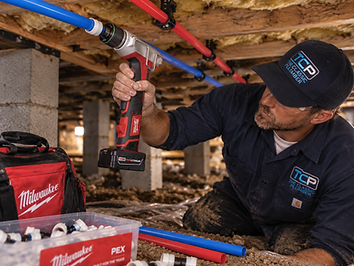
Symptoms Knoxville homeowners call us about
- Repeated leaks in multiple areas of the home — you've repaired three and another appears
- Discolored or rusty water from corroded galvanized or iron piping
- Low pressure across the whole house from scaled galvanized piping
- Pinhole leaks or recurring corrosion concerns in older copper piping
- Polybutylene supply piping that you want evaluated for replacement
- You're planning a remodel and the old piping won't support the new fixtures
- Your home has galvanized supply piping with restriction, corrosion, discoloration, or repeated leaks
Repeated leaks in different areas, discolored water, or widespread flow restrictions can indicate that the piping system is aging or deteriorating beyond one isolated spot. Those signs justify a broader inspection, but they do not automatically mean every home needs a full repipe. We evaluate material, condition, leak history, access, and the remaining system before recommending one.
Still not sure what's going on?
Our AI Plumber can help you narrow it down — describe what you're seeing and it'll walk you through likely causes, safe checks, and whether it's a DIY job or time to call a professional.
What's usually behind these problems
- —Galvanized steel piping that has scaled and corroded from the inside, narrowing flow
- —Polybutylene piping with age-related material or fitting concerns
- —Internal scale or corrosion reducing flow in older metal piping
- —Repeated pinhole leaks or broader corrosion in older copper piping
- —Age-related deterioration combined with repeated leaks, corrosion, or flow restriction
- —Original improper material or installation that's failing prematurely

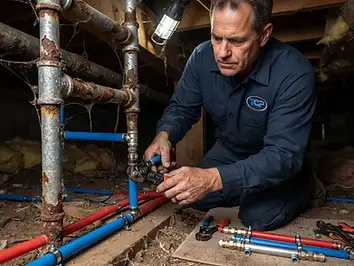
PEX, copper, and what a repipe actually involves
We plan routes to minimize unnecessary access while keeping the piping properly supported and serviceable. PEX can often be routed with fewer fittings than rigid copper, which may reduce access in some homes. We plan water shutdowns with the homeowner and restore service as practical during a multi-day project. Timeline depends heavily on home size, stories, access, fixture count, and the amount of patching required.
The decision between PEX and copper comes down to your home, budget, routing, local requirements, and preference. PEX is flexible and can be more tolerant of freezing conditions than rigid metal pipe, although no water-filled piping should be treated as freeze-proof. Copper is traditional, rigid, durable, and more labor-intensive to route. For a partial repipe, we choose a compatible transition and material based on the condition of the remaining system rather than assuming the whole house needs replacement.
Access is a major factor in disruption. We plan routes through crawlspaces, attics, chases, walls, or ceilings as the home allows, and we explain where access openings may be needed before work begins. The estimate should also make clear what wall or ceiling patching is included and what finish work, if any, is by others.
How we diagnose and fix it

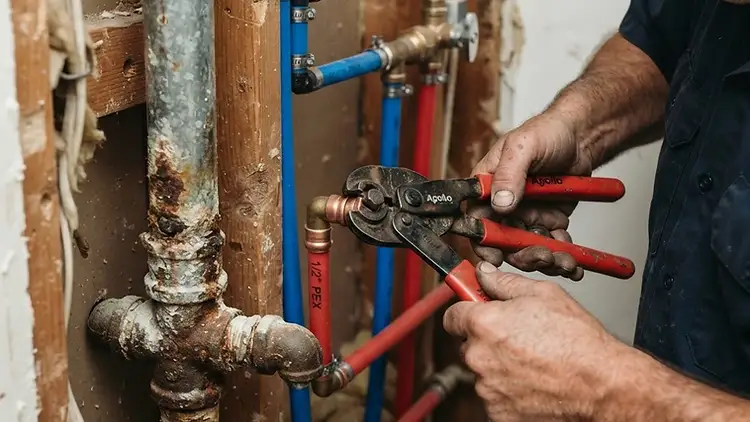
- 01Inspect and assess
We assess the existing material, its condition, the home's layout, and access points to plan the repipe and determine whether a full or partial repipe is the right call.
- 02Recommend a material
We help you choose PEX or copper based on your home, budget, and preference — and explain the trade-offs honestly.
- 03Plan the routes
We plan routes that minimize unnecessary access and explain the expected water-shutdown sequence before work begins.
- 04Repipe and connect
We install the new piping, connect all fixtures, and pressure-test the entire system for leaks before restoring water.
- 05Finish and verify
We verify the new piping and fixture connections, then complete the access/patching scope included in the estimate and explain any remaining finish work.
When to Repipe — and When a Repair Still Makes Sense
- If leaks are recurring in different parts of the same aging piping system, compare the cumulative cost and disruption of repeated repairs with a planned repipe. A single pinhole does not automatically mean the rest of the system will fail next.
- Polybutylene has a documented history of failures in some installations. If your home has it, we identify the material and fittings, discuss the risk and condition, and explain proactive replacement options without pretending we can predict exactly when a line will fail.
- Galvanized piping with significant internal scale or corrosion can create persistent flow and water-quality complaints. When the restriction is widespread, replacement may be more effective than trying to solve a whole-house problem at one fitting or valve.
- PEX is flexible and often requires fewer fittings and less invasive routing than rigid pipe. It can tolerate freezing conditions better than some rigid materials, but it is not freeze-proof and still requires proper installation and protection.
- Copper is traditional, rigid, and durable, but generally more labor-intensive to route than PEX. Material choice should reflect the home's layout, budget, water conditions, local requirements, and homeowner preference.
- A partial repipe makes sense when only one section has failed and the rest is in good condition — we tell you honestly when that's the case.
- We plan shutdowns and work sequencing to minimize time without water, and we explain in advance when temporary service interruptions may be necessary.
- Timeline depends on home size, number of stories, and accessibility — crawlspaces and attics are faster than slab construction.
Repiping Issues We Commonly See in Knoxville Homes
Some older Knoxville-area homes still have galvanized steel supply piping. When internal corrosion and scale become severe, homeowners may notice reduced flow, rusty or discolored water, or repeated leaks. We confirm that the piping itself is the cause before recommending a partial or whole-home replacement.
Some Knoxville-area homes contain polybutylene supply piping from earlier construction eras. Because the material has a documented history of failures in some systems, homeowners often choose to evaluate or replace it proactively, especially when there is a leak history, aging fittings, an insurance concern, or a planned remodel.
Older copper can develop pinhole leaks or corrosion for several reasons, including water chemistry, installation conditions, electrical influences, and age. One pinhole does not prove the rest of the system will fail next, so we look at leak history and the condition of the remaining piping before discussing a repipe.
Learn more about repiping
Real questions, straight answers
Tank, tankless, gas, electric, and point-of-use water heaters — from no-hot-water problems and leaks to planned replacement and installation.
ToiletsRunning, leaking, weak-flushing, or won't flush at all — we fix every common toilet problem and replace units when repair no longer makes sense.
FaucetsDrips, low pressure, hard-to-shut-off handles, and cartridge failures — repaired or replaced for Moen, Delta, Kohler, American Standard, Pfister and more.
Drain CleaningClogged sinks, showers, tubs, floor drains, branch lines, and main sewer lines — diagnosed first, cleared with the right method, and evaluated further when the problem keeps coming back.
Financing may be available for this type of project
Larger plumbing projects can be an unexpected expense. Financing options may be available for qualifying customers.
Learn about financingProperty manager? We handle plumbing for rentals and portfolios.
Tenant coordination, documentation, approval workflows, and turnover repairs — built for property management.
Rather have us handle it?
Request service from The Classic Plumber — Knoxville's plumbing expert.