
Educational Diagram
Standard Gas Water Heater Components
Click image to enlarge
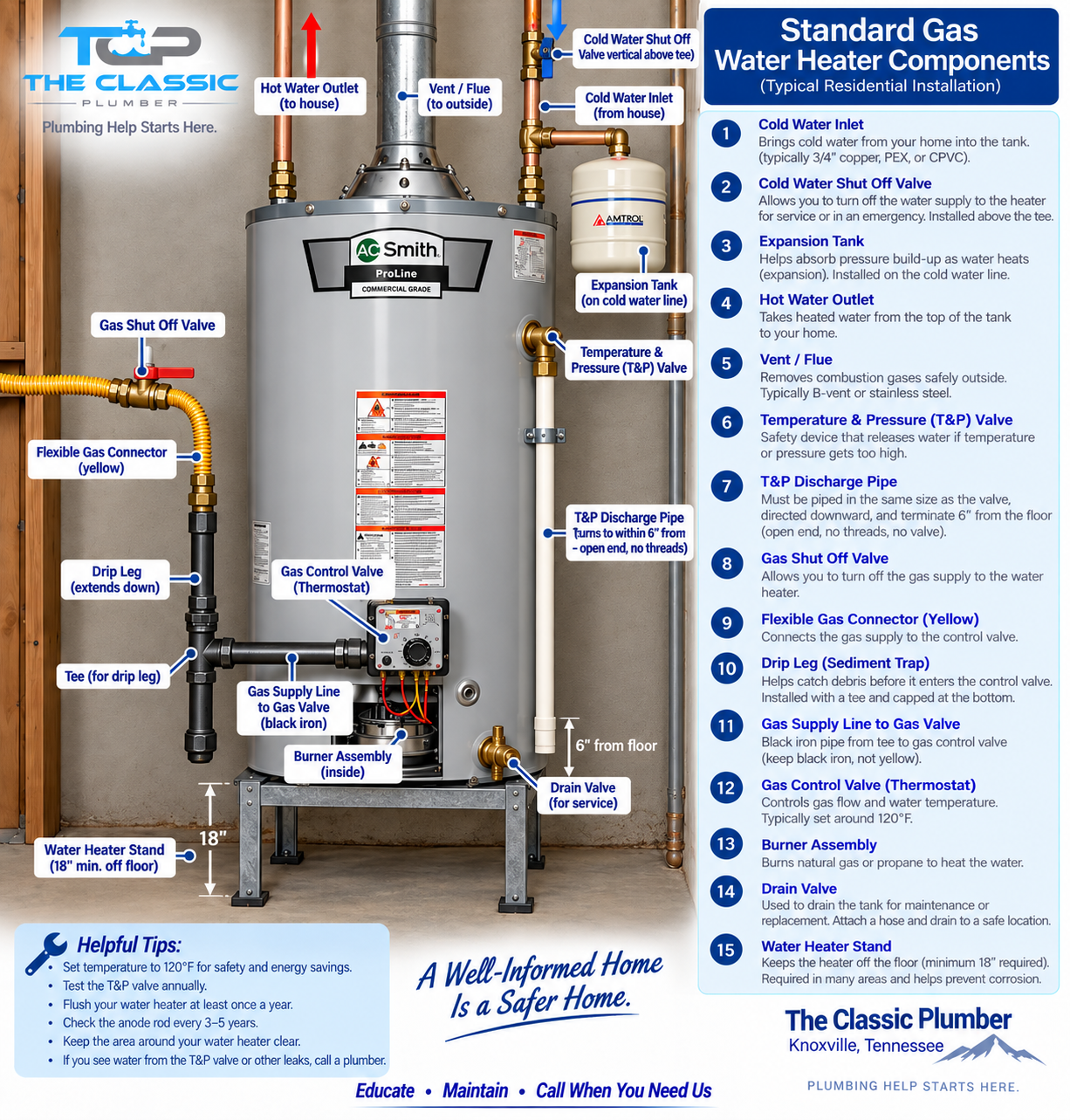
Educational diagram showing a typical residential gas water heater installation. Components, piping arrangements, installation requirements, and clearances may vary by manufacturer, model, fuel type, installation location, and local code. Always follow the manufacturer's instructions and applicable plumbing, fuel-gas, and building requirements.
Learn the major components of a typical residential gas tank water heater, including the hot and cold water connections, water shutoff, expansion tank, venting, T&P safety valve and discharge piping, gas shutoff, flexible gas connector, sediment trap/drip leg, gas supply piping, gas control valve, burner assembly, drain valve, and water heater stand.
Reference checked: component relationships and terminology were reviewed against manufacturer documentation from Rheem. This is original Classic Plumber educational artwork, not a manufacturer drawing.
This labeled diagram shows the major components of a standard residential gas tank water heater (typical installation).
Overview
A tank water heater stores and heats 40–50 gallons of water. A tankless heater heats water on demand as it flows through. Both have safety devices that can trip and cause no-hot-water symptoms. Understanding the basics helps you check the right things before calling.
How It Works
Cold water enters through the dip tube at the bottom. The heating element or burner heats the water. Hot water rises to the top and exits through the hot outlet when you open a tap. The thermostat keeps the water at the set temperature. The T&P valve is a safety device — if the thermostat fails and the water overheats, the T&P opens to release pressure safely.
Key Components
Tank
Stores 30–80 gallons of hot water. Glass-lined to resist corrosion.
Heating Element / Burner
Electric: one or two elements heat the water. Gas: a burner at the bottom.
Thermostat
Controls water temperature. Should be set to 120°F.
T&P Relief Valve
Temperature and pressure safety valve. Opens if pressure or temperature gets too high.
Drain Valve
Near the bottom. Used to flush sediment from the tank.
Dip Tube
Directs cold water to the bottom of the tank so hot water rises to the outlet.
Anode Rod
A sacrificial metal rod that corrodes instead of the tank. Extends tank life.
Expansion Tank (where applicable)
Absorbs pressure from heated water expanding. Required in many closed systems.
Common Issues
No hot water
Tripped breaker (electric), pilot out (gas), or failed element/thermostat.
Read the guideNot enough hot water
Sediment buildup, failing element, or undersized unit.
Popping or rumbling
Sediment buildup in the tank — needs flushing.
T&P valve dripping
High water pressure or a failing valve — may need a thermal expansion tank.
Maintenance Tips
- Flush the tank once a year to remove sediment (especially in Knoxville's hard water).
- Check the T&P valve annually — lift the lever briefly to confirm it works.
- Set the thermostat to 120°F to prevent scalding and save energy.
- Check the anode rod every 3–5 years — a worn rod shortens tank life.
- For tankless: flush annually with a descaler to protect the heat exchanger.