Educational Diagram
Tankless Water Heater Components
Click image to enlarge
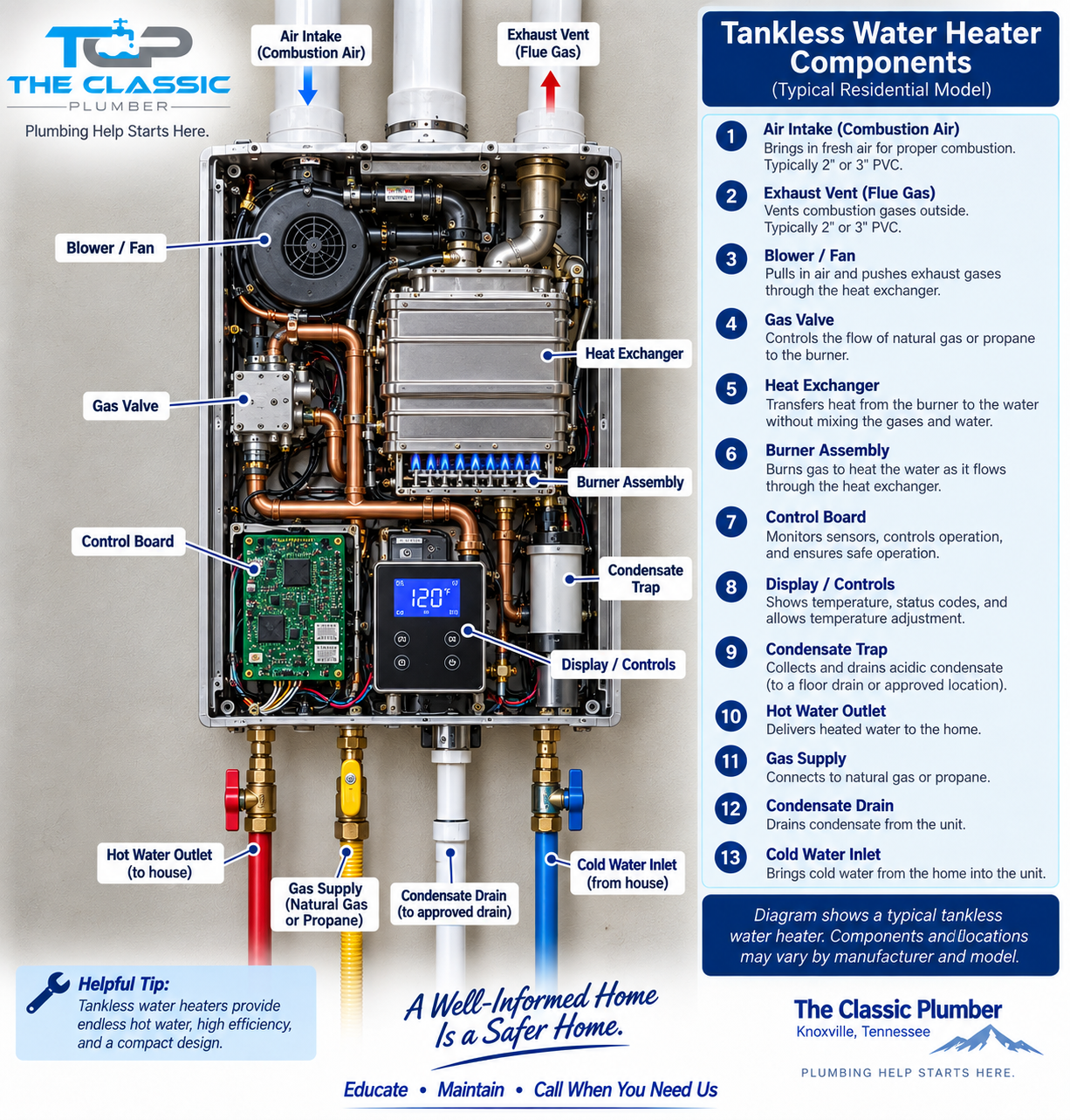
Educational diagram showing a typical residential tankless water heater. Components and internal layouts may vary by manufacturer and model. Always follow the manufacturer's installation and service documentation.
Learn the major components of a typical residential tankless water heater, including the air intake, exhaust vent, blower/fan, gas valve, heat exchanger, burner assembly, control board, display/controls, condensate trap, hot water outlet, gas supply, condensate drain, and cold water inlet.
This labeled diagram shows the major components of a typical residential tankless water heater.
Overview
A tankless water heater heats water only when you need it. When you open a hot tap, a flow sensor detects the water moving, the burner or element fires, and water is heated as it passes through a compact heat exchanger. There's no tank to run out of — but the heat exchanger is sensitive to mineral scale.
How It Works
When you open a hot tap, the flow sensor detects water moving and signals the control board. The burner ignites (gas) or elements energize (electric). Cold water flows through the heat exchanger, is heated instantly, and reaches your tap. When you close the tap, the burner shuts off. Because there's no tank, you never run out — but the flow rate is limited. If multiple fixtures demand hot water at once, the unit may not keep up.
Key Components
Heat Exchanger
A compact coil or block where water is heated instantly. The heart of the unit.
Flow Sensor
Detects when a hot tap opens and triggers the burner or element.
Burner / Element
Gas: a high-output burner. Electric: heating elements inside the exchanger.
Control Board
Manages temperature, ignition, and error codes.
Temperature Sensor
Monitors water temperature and adjusts the burner to maintain the set point.
Isolation Valve Kit
Service valves that allow flushing the heat exchanger with a descaler.
Common Issues
Not heating / error code
Scale in the heat exchanger, gas supply issue, or sensor failure.
Temperature fluctuates
Mineral buildup or a failing flow sensor.
Reduced hot water flow
Scale restricting the heat exchanger channels.
Cold water sandwich
Residual cold water in the line between the unit and the tap.
Maintenance Tips
- Flush annually with a descaler (white vinegar or manufacturer-approved solution). This is the #1 maintenance task.
- Knoxville's hard water makes annual flushing essential — scale builds up fast in the narrow heat exchanger.
- Check the inlet screen filter annually and clean if clogged.
- Keep the error code if the unit displays one — it tells a plumber exactly what's wrong.
- Flushing requires a pump, hoses, and isolation valve kit — most homeowners hire a plumber for this.