Educational Diagram
Tankless Water Heater Components
Click image to enlarge
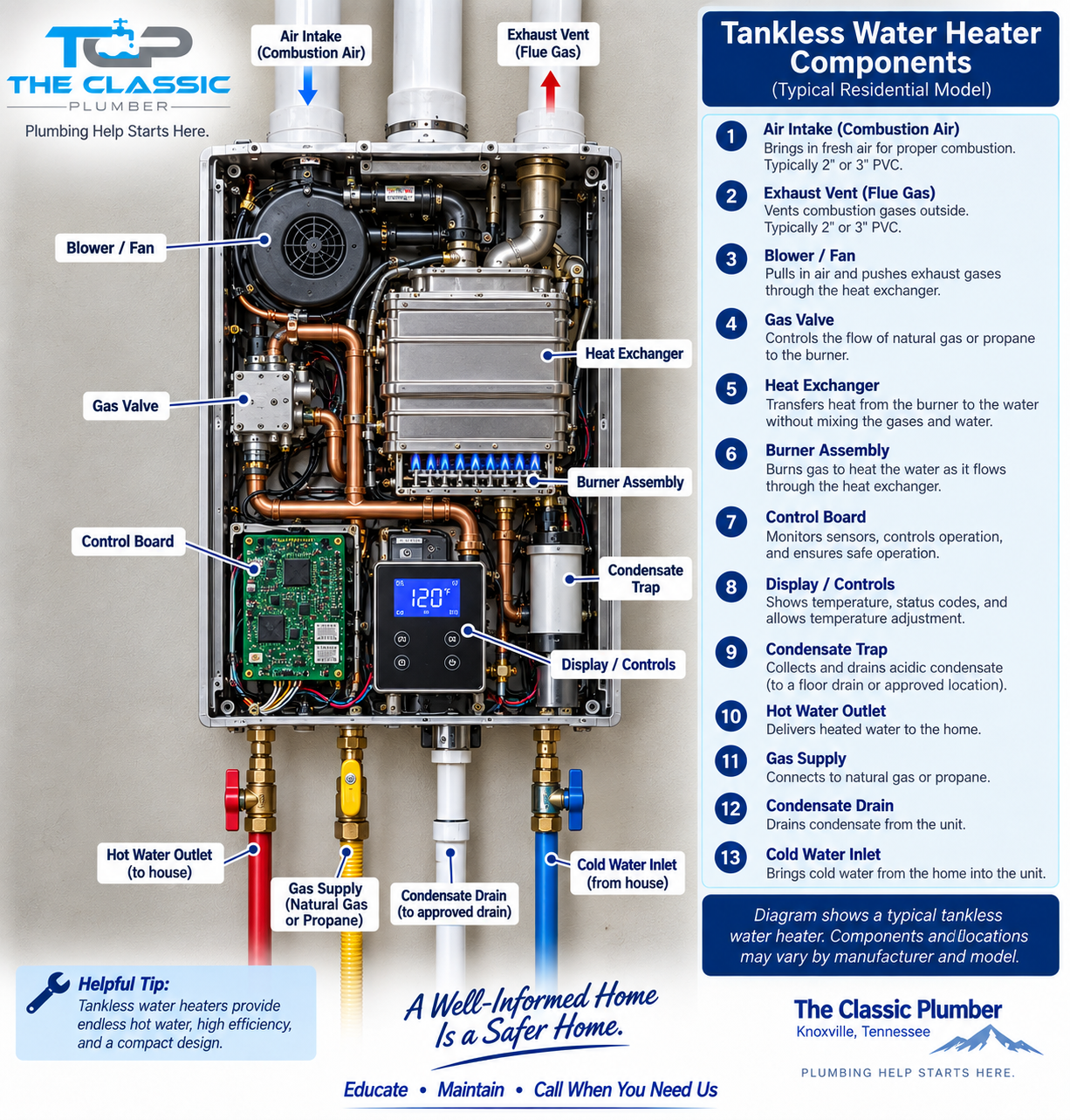
Educational diagram showing a typical residential tankless water heater. Components and internal layouts may vary by manufacturer and model. Always follow the manufacturer's installation and service documentation.
Learn the major components of a typical residential tankless water heater, including the air intake, exhaust vent, blower/fan, gas valve, heat exchanger, burner assembly, control board, display/controls, condensate trap, hot water outlet, gas supply, condensate drain, and cold water inlet.
This labeled diagram shows the major components of a typical residential tankless water heater.
Overview
A tankless water heater heats water only when you need it. When you turn on a hot water faucet, a flow sensor detects the water movement and activates the burner, which heats water instantly as it passes through a heat exchanger. There's no storage tank, no standby heat loss, and — in theory — endless hot water. But tankless units need proper gas supply, clean water, and annual maintenance to perform reliably.
How It Works
When you open a hot water tap, cold water flows into the unit. A flow sensor detects the movement and signals the gas valve to open and the burner to ignite. Water passes through the heat exchanger, where it's heated to the set temperature instantly. When you close the tap, the flow stops and the burner shuts off. There's no tank to run out of — but the unit needs adequate flow, gas supply, and a clean heat exchanger to work properly.
Key Components
Heat Exchanger
Where water is heated instantly as it flows through coils over the burner.
Flow Sensor
Detects water flow and signals the burner to ignite.
Burner
Gas burner that fires on demand to heat the heat exchanger.
Control Panel
Digital display showing temperature and error codes.
Vent Pipe
Carries combustion gases outside. Powered by an internal fan.
Isolation Valves
Allow the unit to be serviced without shutting off the whole house.
Common Issues
No hot water
Flow too low to activate sensor, gas supply issue, or error code. Check the display.
Inconsistent temperature
Scale buildup in the heat exchanger. Needs professional descaling.
Error code on display
Note the code — common ones indicate flow, ignition, or venting issues.
Not enough hot water for multiple fixtures
Unit may be undersized, or flow rate exceeded. Tankless has a maximum flow rate.
Maintenance Tips
- Flush the heat exchanger annually with a descaling solution — essential in Knoxville's hard water.
- Check the display for error codes and note the number before calling for service.
- Ensure isolation valves are installed — they're needed for annual flushing.
- Verify your gas line is adequately sized — tankless units need more gas than tank heaters.